Naamah, Ancient Hebrew demon of temptation and beauty

Naamah is one of the ancient female spirits of the Hebrew mystical tradition, often counted among the four queens of the infernal realms. Her name, meaning “pleasant” or “sweet,” hints at her alluring power—a being said to weave temptation into song and movement. In early writings she was described as a fallen spirit who seduced mortals through sound, voice, and sensual delight, pulling them away from purity of purpose. Later mystical interpretations viewed her as a being who governs the power of attraction itself, illustrating the dual nature of beauty as both holy and perilous.
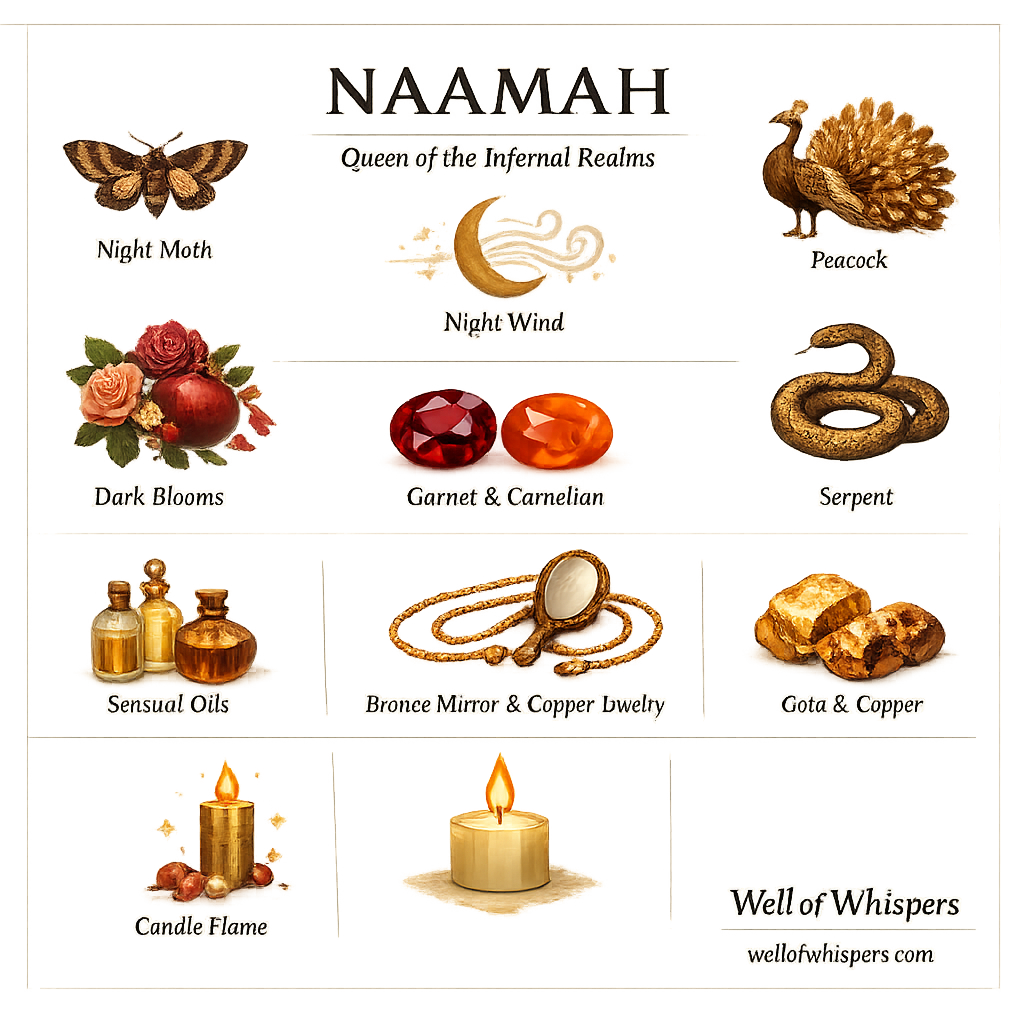
She is associated with the night wind, the shimmer of gold and copper, and the musk of flowers that open only in darkness. The animals connected with her energies are the night moth, the peacock, and the serpent, each symbolizing transformation, vanity, or cyclical renewal. Herbs tied to her spheres include patchouli, damask rose, and pomegranate—plants long used in ancient love rites and incantations calling for fertility or desire. Crystals resonating with her power are carnelian and garnet, which echo the color of blood and the pulse of life, while oils of ylang-ylang or black amber are said to invoke her essence. Objects such as bronze mirrors or copper jewelry hold a magnetic resonance to her and reflect both fascination and warning; as every mirrored surface can flatter but also reveal what we refuse to face.
In older mystical interpretations, Naamah is a teacher of balance through excess—one who shows the spirit how quickly delight can turn into bondage. Her energy moves through music, beauty, and longing; to engage too deeply can obscure one’s higher purpose. Yet when approached symbolically rather than literally, she serves as a stern reminder of discipline within passion and mindfulness within pleasure.
A subtle reflection for today may involve lighting a single candle, gazing at its steady flame, and considering the difference between warmth that nourishes and heat that consumes. Contemplate where desire bends into attachment and where it may be gently reclaimed as strength. If one works with fragrances or objects, allow them to remind you not of indulgence but of awareness—the acknowledgment that temptation and transcendence are both born from the same yearning. Through this practice, one may learn to transform the lure of the outer world into the quiet freedom of inner clarity.