
Pazuzu, Mesopotamian demon of the winds and guardian against plague

Pazuzu, the ancient Mesopotamian demon, was both feared and invoked for protection. Known as the son of the god Hanbi, Pazuzu ruled the southwestern and western winds, which carried sickness and misfortune. Yet despite his fearsome visage—lion’s head, scaly body, talons, and wings—he was often called upon to ward off other demons, most notably Lamashtu, who brought harm to mothers and infants. In this strange duality, Pazuzu embodied the principle that even destructive forces could serve as guardians when properly understood and respected.
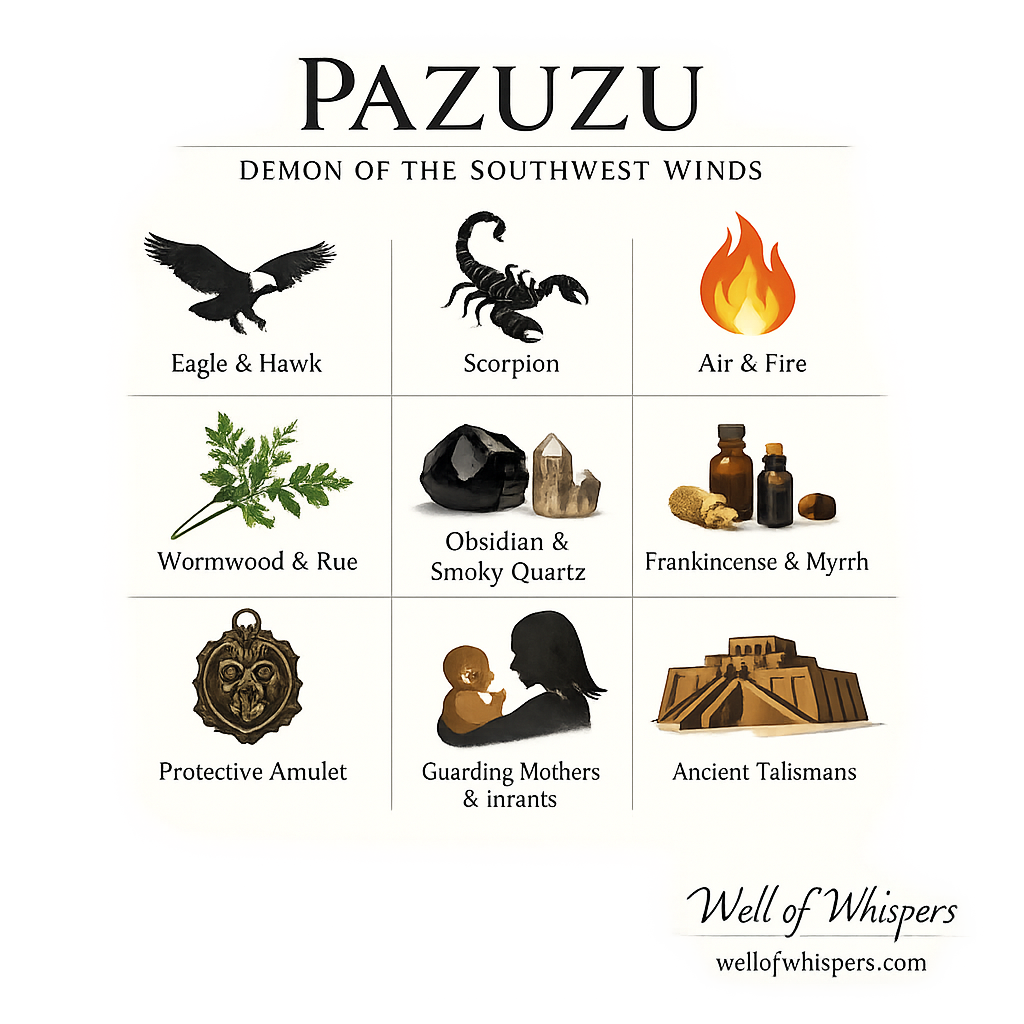
Artifacts bearing his image were once hung around the necks of pregnant women or placed in homes to avert disease and malevolent spirits. His power was not sought for domination but for the redirection of misfortune, a reminder that chaos itself could be harnessed for healing and preservation. The invocation of Pazuzu’s name carried both risk and reverence—he was to be summoned only for protection and dismissed immediately, lest his own stormy nature turn destructive.
Pazuzu’s correspondences draw from both his domain and his paradox. Air and fire align with his nature, representing the destructive wind and the burning fever he could control. The eagle, hawk, and scorpion were sacred to him for their watchful and combative aspects. Herbs like wormwood and rue—bitter, pungent, and protective—were believed to help drive off pestilence. Obsidian and smoky quartz, dark stones that absorb and ground chaotic energy, resonate with his deflective power. Oils such as frankincense and myrrh, used in both purification and funerary rites, reflect his connection to barriers between the living and the unseen.
To meditate upon Pazuzu is to consider the edges between harm and safeguarding. The same storm that levels can also cleanse the air of stagnation. A subtle exercise today might be to light a candle and open a window, allowing a brief gust of fresh air to circulate through the room. As the flame dances, reflect on any inner winds—anger, fear, or restlessness—that could serve a constructive purpose if directed wisely. Just as ancient people invoked a fierce protector to dispel unseen dangers, one might quietly acknowledge that strength does not always appear gentle. The spiritual caution lies in balance: to know one’s own storm, command it without succumbing to it, and remember that protection can wear a fearsome mask.